follow link to:
a selection of photographs from the series
links to the books:
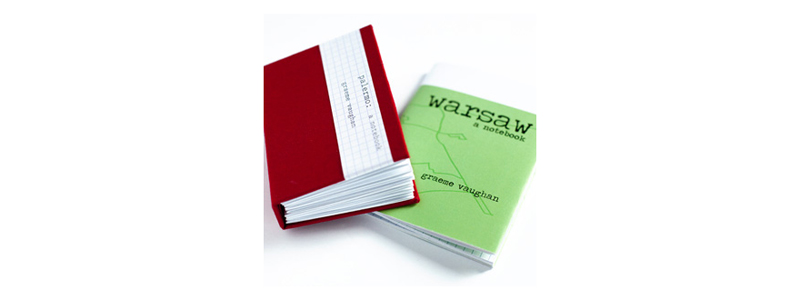
warsaw: a notebook // palermo: a notebook // prague: a notebook
I am a photographer, I go to places I don't know and follow people around.
This work starts from my overall fascination with cities, combined with the question, ‘when can we say that we ‘know’ somewhere?’ Looking for an answer to that question led me to think about the way we navigate and find our way around a place that we don’t know. Each book in the series has taken a city that I’d not previously visited. I decided to start following people, not to use usual tourist routes, signposts or other navigation guides. It seemed to me more entertaining, interesting and potentially more useful to use the people who appeared to ‘know’ the place. I make photographs of the parts of the city that I’m led to by these ‘travel guides’ to unfamiliar places. They are in themselves a record of my own journey, of discovering a new place, but also they are a collection of fragments of a place, which are taken out of the lives of others.
Photography has long been connected to travelling, journeys, and explorations. The ‘urban notebooks’ series fits within this tradition. It adds to this the element of serendipity, of the city as a stage-set where events may or may not occur. Where I decide to follow one person and not another – that decision is entirely mine and is made from a whole variety of reasons such as: ‘red hat’, ‘oversized carrier-bag’, ‘funny walk’, or even ‘nice dog’. The work is dependent on the presence of people in the cities, and these are places where people are in abundance, but not present in the photographs. The work is, above all, about place, but about what place means and comes to mean to us as people who experience it and learn to know it through everyday use.
The work exists in two ways, as a single collection of photographs from many cities visited, and as 3 individual ‘notebooks’ made from work in Prague, Palermo and Warsaw.
The Books
Prague: a notebook. 210 x 150 x 5 mm, stab bound book with 50 pages (25 sheets), and 34 photographs laser printed with a wrap around cover. The cover and binding retain the feel of a notebook. In this publication, the images are selected, sequenced and placed within the pages to provide a sense of journey throughout the book. Connections between different parts of the same city become revealed through formal characteristics of the photographs. Like all the other photographs in the work, they are unified by the square format of the medium format camera used to make them. But in ‘Prague’ the concentration on other elements of colour, shape, content and composition serve to reflect a unified, but random journey.
Palermo: a notebook. 125 x 90 x 25 mm hard-backed notebook, containing 2 ‘maze’ folded sets of pages. In its design it references the physicality of travelling around the city, reading it requires a physical movement back and forward around the pages to view the photographs. It can be confusing, and frustrating to read, and navigate – much like Palermo as a city itself. These are hand made books of 62 pages and 46 inket printed photographs.
Warsaw: a notebook. is the first book in the series, 145 x 105 x 7.5mm with 80 pages (40 sheets), and 43 photographs. The first ‘issue’ was made on extremely low budget, colour laser photocopies, hand stapled and covered with a printed card. Only 25 were made, of which one sample copy is left. The starting point for the book was the basic idea of a traveller’s notebook. Coming from the UK, a notebook with squared paper is distinctively European. As the work was made in Europe I wanted this to be the background for the sheets and the size, needed to be of notebook proportions. Each book was made from folding A3 photocopied sheets – prints of the photographs were made and arranged on the photocopier so that the A3 copies could be folded into 8 pages. These were then randomly arranged and stapled together, the result being that each of the 25 copies had a different ordering of images and blank pages - a reference to the randomness involved in the work.